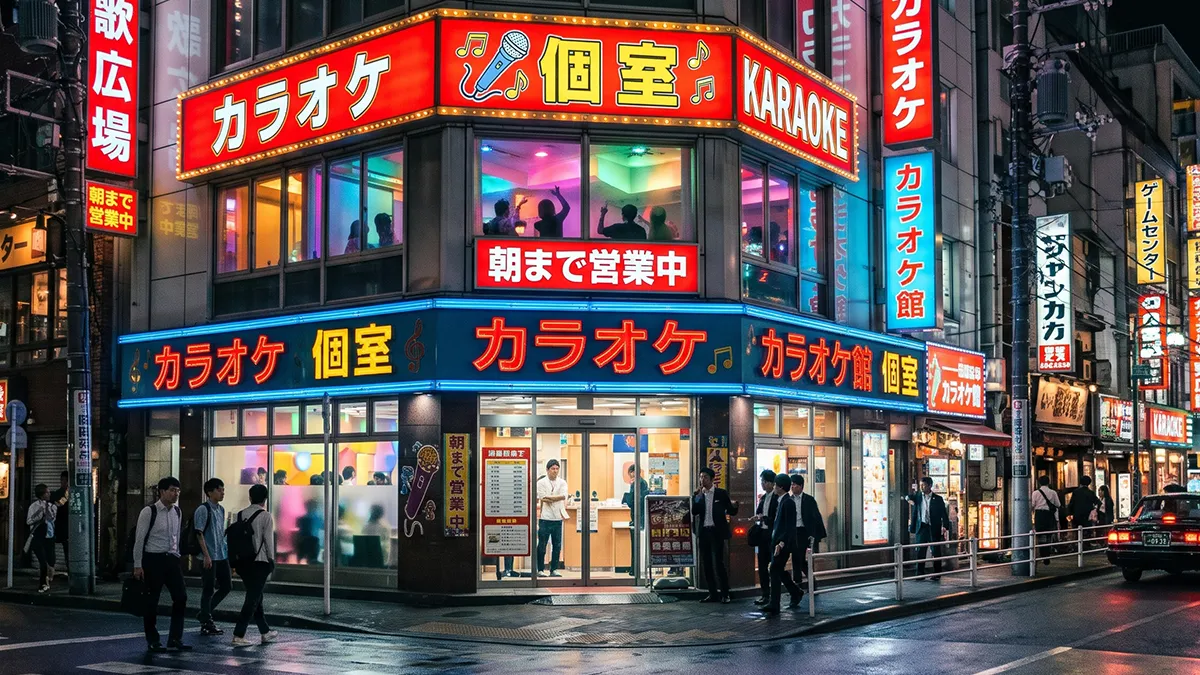

"Karaoke" is one of the Japanese words understood all over the world.
Karaoke was born in Japan in the 1970s and has since spread worldwide, but karaoke in Japan, its home country, is very different from karaoke abroad.
Abroad, the usual style is singing on a bar stage in front of strangers.
Japanese karaoke, on the other hand, takes place in private rooms called "karaoke boxes," where you can sing as much as you like with just your friends, or even on your own.
State-of-the-art sound systems, tens of thousands of songs, food and drinks delivered to your room. Japanese karaoke has become one of the "Japanese cultural experiences you have to try at least once" for foreign travelers.
That said, first-timers probably have questions like these.
- How is the price decided?
- Can I use it if I can't read Japanese?
- Are there English songs?
- Is it weird to go alone?
In this article, we explain how karaoke pricing works in Tokyo, how to use a karaoke box from check-in to checkout, tips for finding English songs, the chains and areas we recommend for foreign visitors, and how to enjoy "solo karaoke," a uniquely Japanese pastime, in a way that even first-timers can follow.
1. Why Japanese Karaoke Is Popular with Foreign Visitors
You sing in a private room with just your friends
Every Japanese karaoke box is a private room.
No strangers will hear you, so you can relax and have fun even if you are not confident in your singing.
The number of songs is overwhelming
Japanese karaoke machines contain an enormous number of songs: not only Japanese songs, but also Western music, K-pop, anime songs and more.
There are plenty of English songs, so you can sing the hits from your own country too.
Prices are reasonable
Depending on the time of day, you can use a room for a few hundred yen per 30 minutes.
You can also order drinks and food in your room, so some people use karaoke instead of an izakaya.
Open late at night, or even until morning
Many karaoke places in nightlife districts stay open late at night or until morning.
They are used to round off a night out, or to kill time after missing the last train.
For ways to spend the night in Tokyo in general, see also A Discerning Adult's Guide to Tokyo Nightlife (2025): Choose Your Perfect Night.
It is also a holy land for anime songs
A rich selection of anime and game songs is something only Japanese karaoke offers.
Some songs can be sung with footage from the anime itself, which makes for a special experience for foreign anime fans.
If you want to experience other aspects of Japanese culture besides karaoke, Experience Traditional Japanese Culture in Tokyo! 5 Samurai, Ninja and Sumo Restaurants & Bars for Foreign Travelers is also worth a look.
2. How Karaoke Pricing Works
Karaoke pricing in Japan works in a way that can be a little confusing for people from abroad. Let's start with the basics.
Price = "per person x time"
In Japanese karaoke, it is common to be charged "per person, per 30 minutes," not per room.
For example, if three people stay for one hour at a place charging 300 yen per 30 minutes, the total is 300 yen x 2 (30 minutes x 2) x 3 people = 1,800 yen.
Prices change by time of day and day of the week
| Time of day | Guide price per 30 minutes (per person) |
|---|---|
| Weekday daytime (until 6 p.m.) | About 120-300 yen |
| Weekday evening (after 6 p.m.) | About 280-550 yen |
| Weekends and public holidays | Often 20-40% higher than evening rates |
*These are guide prices for members. They vary greatly by location and area.
As a real example, at one branch of a major chain in Shinjuku, the 30-minute rate on weekend nights is 660 yen for members and 950 yen for non-members (as of November 2026).
Keep in mind that weekend nights in nightlife districts can cost more than the guide prices listed here.
Watch out for the "one-drink rule"
At many karaoke places, each person must order at least one drink (the one-drink rule).
Drinks cost about 300-500 yen each and are not included in the displayed room charge.
Signing up as a member makes it cheaper
At most chains, you can register as a member for free at the front desk and get a big discount on the room charge.
If you plan to go more than once, it pays to sign up the first time.
Free time and all-you-can-drink
There are also "free time" plans that let you sing for as many hours as you like within a set time slot, and plans with all-you-can-drink beverages.
| Plan | Guide price (per person) |
|---|---|
| Weekday evening free time (drink included) | About 1,600-2,200 yen |
| Weekend evening free time (drink included) | About 2,200-3,000 yen |
| All-you-can-drink add-on | About 600-900 yen |
| Late-night to morning free time | About 2,000-3,000 yen |
If you plan to sing for a long time, free time almost always works out cheaper than paying per 30 minutes.
Mornings and daytime are a bargain
From opening time through the morning, some plans are surprisingly cheap.
For example, at the major chain Manekineko, the room charge for "Asa-uta" (morning singing), available if you enter between opening time and 10:59 a.m., is about 55-132 yen per 30 minutes depending on the branch (member price; drinks charged separately).
You could even sing for a little while before heading out to sightsee.
3. How to Use Karaoke: From Check-in to Checkout
Here is the typical flow so you won't get lost, even on your first visit.
STEP 1: Tell the front desk how many people and how long
When you enter, go to the front desk first.
Tell the staff the number of people and how long you want to stay (30 minutes, 1 hour, free time, etc.).
Even if English doesn't get through, showing the number with your fingers or pointing at the price list is more than enough.
At this point, you may be asked whether you want to register as a member.
Registering gets you a discount, so do it if you have time.
STEP 2: Go to your room
After check-in, you will be handed a slip or card with your room number, and microphones.
Head to the room you have been given.
STEP 3: Choose songs on the tablet
Each room has a tablet for choosing songs.
Many models have an English display mode that lets you search by song title or artist name.
Select a song and send it, and the lyrics will appear on the screen as the song starts.
STEP 4: Order drinks and food
Order drinks and food from the tablet or the phone in your room.
At places with the one-drink rule, order one drink first.
STEP 5: Answer the phone call 10 minutes before the end
About 10 minutes before your time is up, the phone in your room will ring.
Tell the staff whether you want to extend or leave on time.
If you don't want to extend, just saying "OK" or "No extension" is fine.
STEP 6: Pay at the front desk
When you leave, take your slip to the front desk and pay.
Many places accept credit cards, but it is reassuring to have some cash just in case.
4. Tips for Finding English Songs
There are two kinds of karaoke machines in Japan
Japanese karaoke machines are mainly of two kinds: "DAM" and "JOYSOUND."
Both have an English display mode and include a large number of Western songs.
| Machine | Features |
|---|---|
| DAM | Said to add new Western songs quickly. Big Echo uses DAM |
| JOYSOUND | A wide range of songs. Many Karaoke Kan and Utahiroba branches use JOYSOUND |
Search tips
- When searching by song title, type it in the Latin alphabet
- Look in the "Western music" category
- If you already know which songs you want to sing, check the DAM or JOYSOUND official website beforehand to see whether they are available
If there is a song you absolutely want to sing, check which machine a place uses before you go in to be sure.
5. Karaoke Chains in Tokyo We Recommend for Foreign Visitors
| Chain | Features |
|---|---|
| Big Echo | A major chain with many branches in Tokyo. Uses DAM. Supports English on-screen display, and some branches have themed rooms and VIP rooms |
| Karaoke Kan | Some branches have menus in English, Chinese and Korean. The Shibuya main branch is known as a filming location for the movie Lost in Translation |
| Pasela Resorts | An upscale chain with resort-style interiors and themed rooms. Its food menu is extensive, and its signature "Honey Toast" is popular. Prices are somewhat higher |
| Karaoke no Tetsujin | Some branches have both DAM and JOYSOUND. Puts effort into services for travelers |
| Manekineko | A chain with many branches nationwide. Some branches allow you to bring your own food and drinks (check the branch's rules) |
| 1Kara | A karaoke chain specializing in solo singers. Introduced in detail in "7. How to Enjoy Solo Karaoke (Hitokara)" |
*Services vary by branch. Check each place's official website before you go.
6. By Area: Where to Enjoy Karaoke
Shinjuku
One of the areas with the most karaoke places in Tokyo.
Major chains are concentrated in Kabukicho and around Shinjuku Station, and many stay open late into the night.
It is convenient for dropping in straight after a night out.
Shibuya
Shibuya, the city of young people, has many karaoke places, starting with Karaoke Kan's Shibuya main branch.
If you are a fan of the film, visiting the setting of Lost in Translation could be fun.
We cover how to spend the night in Shibuya in detail in What Time Does Shibuya's Nightlife End? Your Guide to Tokyo's Entertainment Hub!.
Roppongi
A nightlife district where many foreigners gather.
There are upscale karaoke places and karaoke bars, making it a good place to enjoy karaoke with foreign friends.
Akihabara
Akihabara, the holy land of anime and games, is perfect for anyone who wants to belt out anime songs.
There are places with themed rooms as well as solo karaoke places.
Before or after karaoke, we also recommend stopping by one of the maid cafes introduced in [2026 Ultimate Guide] Akihabara Maid Cafes: How to Enjoy & Top Picks.
Ikebukuro and Ueno
Ikebukuro and Ueno also have major chains and solo karaoke places.
You can enjoy karaoke casually near your hotel.
We have put together Ikebukuro's fun spots in The Ultimate Guide to Ikebukuro's Playgrounds (2026 Edition): 16 Must-Visit Spots!.
7. How to Enjoy Solo Karaoke (Hitokara)
In Japan, solo karaoke is completely normal
In Japan, going to karaoke alone, known as "hitokara," is a very common way to have fun.
People who want to practice singing, blow off steam, or sing their favorite songs without worrying about anyone else use karaoke boxes on their own.
Almost all major chains can be used by a single person in the usual way.
Just say "One person" at the front desk.
Some places charge extra for a single person (for example, an extra 110 yen per 30 minutes).
Especially recommended for solo travelers
Evenings on a solo trip can leave you with surprisingly more time than you know what to do with.
Walking into a bar alone takes courage, but in a karaoke box you can spend time at your own pace without worrying about anyone's eyes.
- Sing your favorite songs, in any order, as many times as you like
- Nobody hears you, even if you are off-key
- When you get tired, take a break with a drink
- Sing songs from home and ease a little homesickness
1Kara, a karaoke chain specializing in solo singers
Tokyo has "1Kara," a karaoke chain specializing in solo singers.
Each soundproofed single booth is equipped with a professional-grade microphone and headphones, so you can sing while hearing your own voice clearly.
There are branches in Shinjuku, Ikebukuro, Ueno and elsewhere.
Tips for enjoying solo karaoke
- Go during the cheap daytime or morning hours and you can enjoy it for a few hundred yen
- Get a discount by registering as a member
- Use the scoring function and challenge your own score
- Try singing Japanese songs or anime songs you have been curious about
From the editorial team: solo karaoke and Japan's "ohitorisama culture"
To tell the truth, I often go to karaoke with friends, but I have never been to karaoke alone.
Even so, I'd like to try it someday if I get the chance.
On the other hand, when I told a friend from abroad about solo karaoke, he didn't seem to have a very good impression of it.
In his words: "Singing is something you do in front of everyone. Is it fun going alone? I'd think you don't have any friends."
Quite a few people abroad may feel the same way he does.
In Japan, however, there is a way of thinking known as "ohitorisama culture," the culture of doing things on your own.
Spending lively times with lots of friends is fun, but there is also the quiet you can only enjoy alone, time that flows slowly, and the ease of doing as you please without worrying about how others see you.
Finding enjoyment in these things is what Japan's ohitorisama culture is all about.
Not only solo karaoke, but also eating yakiniku alone and traveling alone have become completely ordinary ways to enjoy yourself in Japan.
Perhaps the appeal of this culture is something you can only understand by experiencing it yourself.
If you ever have an evening to yourself in Tokyo, why not head to a karaoke box on your own and get a taste of Japan's ohitorisama culture?
8. Karaoke Etiquette Worth Knowing
Japanese karaoke has some etiquette that is not widely known abroad.
When you go as a group, keep the following in mind.
- Queue songs one at a time, taking turns, and don't reserve lots of songs at once
- Don't immediately sing the same song the previous person just sang
- Don't keep looking at your smartphone while others are singing
- Check with everyone before using the scoring function
- For the first song, choose an upbeat song everyone knows
- Don't put the microphone right against your mouth; hold it a few centimeters away
Also, handle the equipment and microphones with care, and try not to leave the room too messy.
9. Tips for Combining Nightlife and Karaoke
Booking is recommended on weekend nights
Karaoke places in nightlife districts get crowded on Friday and Saturday nights (especially from around 10 p.m. to 2 a.m.).
If you are going at these times, booking in advance on the place's website or app gives you peace of mind.
If you'd like to hop between clubs and karaoke, see also Shibuya Nightclub Price Guide: 5 Recommended Clubs for First-Timers.
An option when you miss the last train
At places with late-night to morning free time plans, you can also pass the time after the last train has gone.
However, karaoke places are not accommodation.
Using them with the intention of sleeping may be prohibited by the place's rules, so think about how you will get home in advance.
Be careful not to drink too much
With all-you-can-drink plans, it is easy to drink more than you intended.
Enjoy yourself in moderation so you don't fall asleep in the room or cause trouble after drinking too much.
We have put together the risks to watch out for in Tokyo at night in Is Tokyo Nightlife Really Safe? 5 Fatal Risks for Tourists & The Ultimate Survival Manual.
Summary: When in Tokyo, Try Authentic Karaoke at Least Once
Japanese karaoke, where you can sing casually in a private room, is a culture completely different from karaoke abroad.
- The basic price is "per person x 30 minutes," and it changes by time of day and day of the week
- Many places have a one-drink rule, and registering as a member gets you a discount
- The tablets support English mode, and there are plenty of Western songs
- DAM and JOYSOUND have different song catalogs, so checking in advance is the surest way
- Solo karaoke is completely normal in Japan, and it is also recommended for evenings on a solo trip
Singing loudly with friends and singing to your heart's content on your own are both ways to enjoy authentic karaoke.
When you visit Tokyo, be sure to stop by a karaoke box at least once.
If you are planning your whole trip to Tokyo, see also 【2026 Latest】Your Ultimate Tokyo Itinerary: Must-Visit Spots & 5-Night, 6-Day Plans for Foreigners.
Frequently Asked Questions (FAQ)
- Q1. Can I use karaoke even if I don't speak Japanese?
- A1. Yes. At the front desk you only need to tell them the number of people and the time, and pointing with your fingers is more than enough. The tablets in the rooms are often models that support English display, and you can search for English songs.
- Q2. How many English songs are there?
- A2. Both DAM and JOYSOUND include a large number of Western songs. If you want to sing a specific song, checking each company's official website beforehand to see whether it is available is the surest way.
- Q3. Is it okay to go to karaoke alone?
- A3. No problem at all. In Japan, solo karaoke (hitokara) is a very common way to have fun, and almost all major chains can be used by a single person. There are also karaoke places that specialize in solo singers.
- Q4. How much does karaoke cost?
- A4. It depends on the time of day and the place, but on weekday evenings about 280-550 yen per person per 30 minutes is a rough guide. At many places, you also pay separately for at least one drink per person (about 300-500 yen). On weekend nights in nightlife districts, it can cost more than this.
- Q5. Can I go with children?
- A5. Families are welcome. However, under a Tokyo Metropolitan ordinance, people under 18 are restricted from using karaoke late at night. If you go as a family, use it during the hours up to early evening.
We also introduce adult content. If you are interested, please check out the link below.
>> Find an escort service