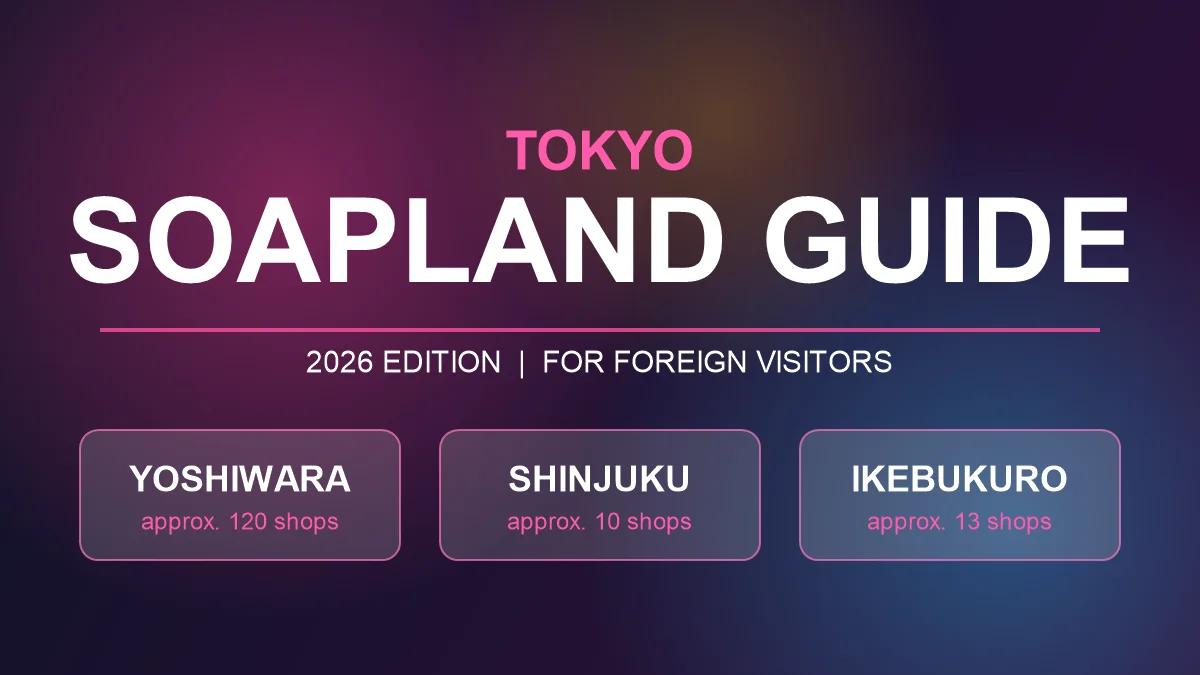
Tokyo's soaplands are concentrated in three areas: about 120 shops in Yoshiwara (Taito Ward), about 10 in Shinjuku's Kabukicho, and about 13 in Ikebukuro. The number of shops that accept foreign visitors grows every year, and Yoshiwara's main street now has signboards pointing foreign customers to shops that will take them. Prices are quoted as a total of "bathing fee plus service fee": budget shops start around 15,000 yen, while high-class shops run 60,000 to 80,000 yen. Booking is still mostly done by phone in Japanese, but shops that accept LINE or WhatsApp, and English-speaking booking services, make it possible even if you speak no Japanese at all.
This article is a complete guide for foreign travelers who want to visit a soapland in Tokyo. It covers each area's character, how pricing works, how to tell which shops accept foreigners, the booking steps, what happens on the day and the house rules, and answers to the questions foreign visitors ask most often. The legal background and individual reviews of luxury and budget shops are covered in dedicated articles linked below.
What Is a Soapland? Tokyo's Three Main Areas and Shop Counts
A soapland is a uniquely Japanese type of establishment where a female cast member provides a bathing service in a private bathroom. Legally, soaplands operate as "private-room bathhouses," and the legal position together with the "free love" pretext is explained in detail in The Truth About Soaplands in Japan: Is Full Service Really Illegal?. This article focuses on the practical side of visiting one.
Almost all of Tokyo's soaplands are found in the following three areas. Shop counts are based on the area map published by Tokyo Soap Tettei Koryaku (as of July 1, 2026, in Japanese).
1. Yoshiwara (Senzoku, Taito Ward): Japan's Largest Soapland District, About 120 Shops
Roughly 120 shops are packed into a block of about 200 by 380 meters, making it the largest soapland district in the country. Every price tier is represented, from budget shops to luxury shops charging over 80,000 yen, so it is the best area for a first-timer to compare options. After dark the street lights up with shop signs and takes on an atmosphere of its own.
- Location: Around Senzoku 4-chome, Taito Ward, Tokyo
- Nearest station: About 15 minutes on foot from Minowa Station (Tokyo Metro Hibiya Line). About 10 minutes by taxi from Asakusa (1,000 to 1,500 yen)
- Character: The largest choice of shops and price ranges in Japan. Many shops offer a free shuttle from Minowa Station and Asakusa Station
For detailed directions, see The Complete Guide to Tokyo's Yoshiwara [2026 Edition]: Access, History, and How to Enjoy It Today.
2. Shinjuku / Kabukicho: About 10 Shops, Best for Easy Access
Eight shops operate in Kabukicho, Japan's largest entertainment district, and two more in Shinjuku Ni-chome. The big advantage is that everything is within walking distance of Shinjuku Station, which suits visitors staying around Shinjuku or anyone who would rather not travel late at night. Because there are fewer shops, popular ones fill up quickly.
- Location: Kabukicho, Shinjuku Ward, Tokyo
- Nearest station: About 10 minutes on foot from the east exit of Shinjuku Station (JR and other lines), about 5 minutes from Seibu-Shinjuku Station
- Character: In the heart of the city's biggest nightlife district, easy to combine with dinner or sightseeing
3. Ikebukuro: About 13 Shops, Clustered on the West Side
Eleven shops operate on the west (north) exit side of Ikebukuro Station and two on the east side. They are clustered around Nishi-Ichibangai and Tokiwa-dori near the west exit, so they are close to the station. The choice is smaller than in Yoshiwara, but it is a convenient area if you are staying in Ikebukuro.
- Location: Nishi-Ikebukuro and Higashi-Ikebukuro, Toshima Ward, Tokyo
- Nearest station: About 5 minutes on foot from the west exit of Ikebukuro Station (JR and other lines)
- Character: Right by the station. Also known as a subculture hub, so easy to pair with sightseeing
A single shop each can also be found in Shibuya, Gotanda, Otsuka, Kichijoji, and a few other places, but given the range of choice and the track record with foreign customers, first-timers should start with Yoshiwara.
How Pricing Works: Bathing Fee + Service Fee = Total
Soapland prices are split into a "bathing fee" and a "service fee," and the sum of the two is what you pay. Nominally the bathing fee goes to the shop and the service fee to the cast member, and at most shops the service fee is set at 1.5 to 2 times the bathing fee (source: explanation of soapland bathing fees, service fees, and totals, in Japanese). If a shop's website lists only the bathing fee, expect the real total to be 2.5 to 3 times that figure.
Typical Totals and Session Lengths by Tier
- Budget shops: 10,000 to 25,000 yen total / 40 to 90 minutes
- Standard and mid-range shops: 25,000 to 50,000 yen total / 90 to 100 minutes
- High-class shops: 50,000 to 80,000 yen total / 110 to 180 minutes
- Ultra high-class shops: 80,000 yen and up / 120 to 180 minutes
In Yoshiwara, totals range from roughly 35,000 to 85,000 yen depending on the tier. A first-visit membership fee (1,000 to 2,000 yen), a selection fee for choosing a specific cast member (1,000 to 2,000 yen), and extension charges may be added.
The Reality of "Foreigner Fees"
One thing foreign visitors need to know is that some shops charge foreign customers a different price from Japanese customers. In the shop lists shared by the English-speaking user community (Reddit r/Japanese_Fuzoku), the extra ranges from nothing at all to a few thousand yen, and at some shops tens of thousands of yen. If you budget from the listed price alone, you may be asked for 1.5 to 2 times that amount on the day, so always confirm "the total for a foreign customer" when you book.
Payment Is Basically Cash in Japanese Yen
The norm is to pay the full amount in cash at reception before your session. Some shops accept credit cards, but they may add a handling charge, and quite a few shops take cards only for the bathing fee and require cash for the service fee. Bring Japanese yen with a little margin above the quoted total.
How to Tell Which Shops Accept Foreigners, and How to Book
Where Things Stand
"No foreigners" used to be the norm in Yoshiwara, but that is changing. A 2024 feature reported that signboards for foreign customers had been installed on Yoshiwara's main street listing the shops that accept them, and that a budget-shop group had put up signs in English, Chinese, and Korean (source: FRIDAY Digital, "Tour groups pouring into high-class shops: the history and current state of Yoshiwara's soapland district, popular with inbound tourists," July 20, 2024, in Japanese). At the same time, many shops still turn away customers who cannot speak Japanese, so the honest answer is "it depends on the shop."
Three Things to Check
- The official website has English, Chinese, or Korean pages: Multilingual shops are expecting foreign customers. Conversely, a Japanese-only site with no mention of foreigners means acceptance is uncertain
- A "foreigners welcome" tag on portal sites: Japanese adult-entertainment portals let you filter for shops that welcome foreigners. Even with the tag, you can still be turned away on the day at the discretion of the staff or the cast member
- Confirm the Japanese level required: It ranges from "greetings are enough" to "you need conversational Japanese." It is also worth asking at booking whether they are fine with communicating through a translation app
Booking Steps: You Do Not Need a Japanese Phone Number
Booking is still mostly done by phone in Japanese, but foreign visitors have three options.
- Contact a LINE- or WhatsApp-friendly shop directly: Most shops that welcome foreigners accept bookings through messaging apps. Give your preferred date and time, course, cast member, nationality, and Japanese level up front and the exchange will go smoothly
- Ask your hotel concierge: Hotels used to foreign guests will sometimes make the phone booking for you
- Use an English-speaking booking service: Services like the booking concierge introduced in 【Free Service】Eliminate Booking Worries! Your Complete Guide to Safe Adult Entertainment in Japan act as a go-between with the shop in English, Chinese, and Korean, and can also confirm the foreigner fee and the Japanese level required on your behalf
Popular Yoshiwara shops sometimes only take bookings on the day or the day before, while high-class shops can be fully booked several days ahead. Get in touch as soon as your dates are set.
What You Need at the Door
Japanese law (the Adult Entertainment Business Act) requires an age check, so showing your passport is mandatory. Most shops will not accept a copy or a photo, so bring the original. Detailed questions about ID and payment, including hotel use, are answered in "Which Hotels Are OK?" The Complete Q&A Guide to Avoiding Trouble and Using Outcall Escort Services in Tokyo.
What Happens on the Day, and the Rules to Follow
From Arrival to Departure
- Reception: Give your booking name, show your passport, confirm the course, and pay the total up front
- Waiting room: Wait in the lounge until your turn. Whether smoking or drinks are allowed depends on the shop
- Your cast member comes to get you: She meets you in the waiting room and takes you to the private room
- Bathing: She washes you in the private bathroom. This is the defining feature of a soapland
- Time in the room: After the bath, the rest of the session takes place on the bed. Breaks and conversation are part of the course time
- Leaving: When time is up, you shower, get dressed, and she sees you out. Most shops route you out without passing back through reception
Rules Foreign Customers Need to Take Seriously
- No photos or recordings of any kind: Just taking your phone out in the room can get you asked to leave. The same goes for photos of the premises
- Respect the limits the cast member sets: What is and is not on offer is decided by the cast member and the shop. Many shops apply different conditions to foreign customers than to Japanese customers, such as mandatory condom use or restrictions on kissing, and these are not negotiable. Pushing will not only end your session on the spot, it can cause the shop to stop accepting foreigners altogether
- No entry if drunk or unwell: You will be refused after drinking, and likewise if you may have an infection
- Tattoos are basically not an issue: Everything happens in a private room, so unlike public baths or pools, being refused because of a tattoo is rare. See [Tattoo Friendly] Tattoos Are Fine at Tokyo Escort Services: The Real No-Go Spots Are Public Baths, Pools and Tanning Salons for details
- Cleanliness: Showering beforehand and trimming your nails is basic etiquette. Most waiting rooms have nail clippers available
Frequently Asked Questions from Foreign Visitors
Q1. Can I get into a Tokyo soapland if I speak no Japanese at all?
A1. Some shops will take you, but they are not the majority. Realistically, stick to shops that explicitly welcome foreigners or go through an English-speaking booking service. The cast member will not necessarily speak English, so you will be using a translation app in the room, and most shops that accept foreigners expect that.
Q2. How much is the foreigner fee?
A2. It ranges from "none" to tens of thousands of yen depending on the shop. Reports in the English-speaking community commonly mention around 10,000 yen at high-class shops with an 80,000 yen total, and a few thousand to 20,000 yen at budget shops, but it varies by shop, so confirm the foreign-customer total when booking. It can come close to double the listed price.
Q3. I don't have a Japanese phone number. Can I still book?
A3. Yes. Contact a LINE- or WhatsApp-friendly shop directly, or have a hotel concierge or an English-speaking booking service make the call for you. A travel SIM without SMS is no problem as long as you can use a messaging app.
Q4. How do I get to Yoshiwara?
A4. About 15 minutes on foot from Minowa Station on the Tokyo Metro Hibiya Line, or about 10 minutes by taxi from Asakusa. Many shops run a free shuttle from Minowa Station and Asakusa Station, so ask about it when you book and you will not get lost.
Q5. Can I be turned away because of my body type or nationality?
A5. Unfortunately, yes. Because each cast member decides individually whether to accept a customer, there is always some chance of being refused on the day even at a shop that accepts foreigners. Being upfront about yourself at booking, including nationality, build, and Japanese level, is the best way to avoid being turned away at the door.
Q6. For a first visit, is a high-class shop or a budget shop better?
A6. If your budget allows, mid-range to high-class shops that are used to foreign customers tend to give fewer bad surprises. Budget shops have shorter sessions, and the foreigner fee makes up a relatively larger share of the total. For a concrete comparison of Yoshiwara's high-class shops, see Experience Ultimate Bliss in Yoshiwara: A Complete Guide to Tokyo's Luxury Soaplands [2026 Edition].
A soapland is an experience you can only have in Japan, but for foreign visitors the three big hurdles are "will they let me in," "how much is it really," and "how do I book." With the information in this article, choosing a foreigner-friendly shop and confirming the conditions at booking removes almost all of them. If you are unsure about booking or choosing a shop, feel free to use the service below.
>> Find an escort service