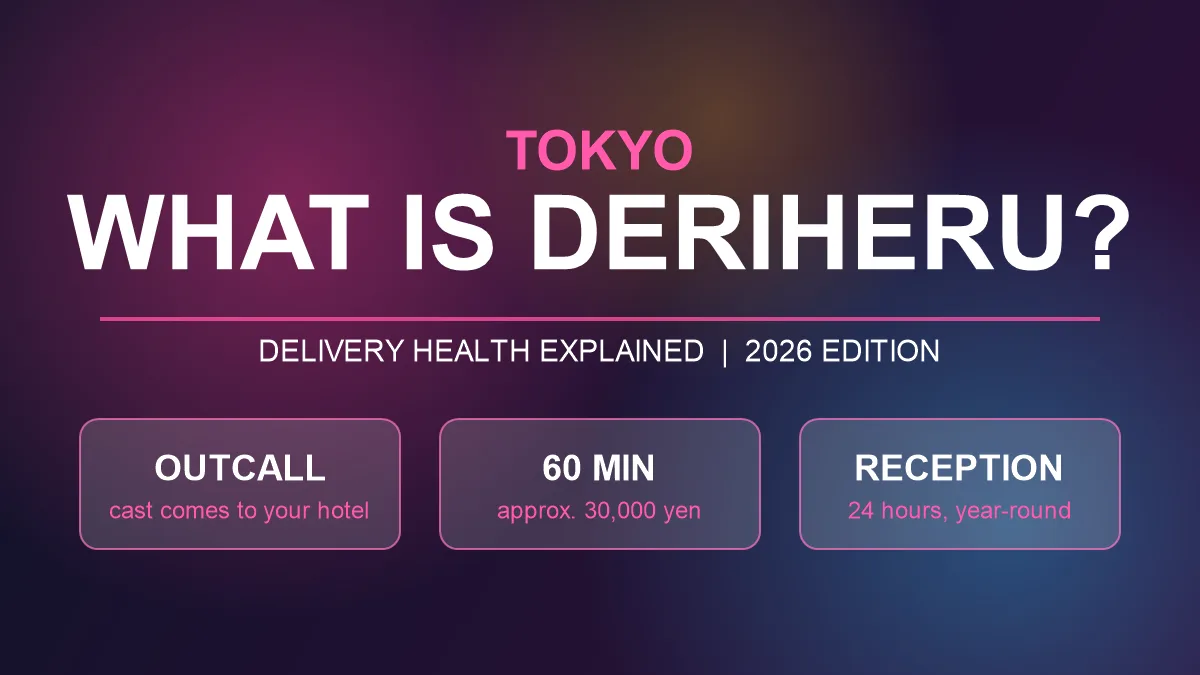

Deriheru (also spelled deliheru, short for "delivery health") is Japan's outcall escort service. Instead of visiting a shop, you book a cast member who comes to your hotel room or residence. In legal terms it belongs to the "non-store sex-related special business" category of the Amusement Business Act, and every shop operates on a notification filed with the Public Safety Commission.
Of the adult services a foreign visitor can realistically use in Tokyo, Delivery Health has the largest number of shops, includes shops that take bookings around the clock, and takes place in the room you are already staying in. Three things trip visitors up: how the price adds up, which hotels allow it, and how to get the booking made.
This article covers what the business type actually is, what you pay, the steps from booking to the end of the session, and what to confirm before you book — based on the statutes and on the price lists of the 15 shops listed on this site.
What Deriheru Is: a "Non-Store Sex-Related Special Business"
Under the Amusement Business Act (the Act on Control and Improvement of Amusement Businesses), deriheru is classified as a "non-store sex-related special business": a business that dispatches women to residences or lodging facilities to provide services, and that is required to file a notification with the Public Safety Commission (source: e-Gov, Act on Control and Improvement of Amusement Businesses, Article 2(7) and Article 31-2, in Japanese). In Tokyo, the operator files a "notification of commencement of a non-store sex-related special business" (form No. 25) with the police station covering the office that serves as the base of the business (source: Tokyo Metropolitan Police Department, notifications for sex-related special businesses, in Japanese).
The main difference from a soapland or a store-based Fashion Health shop is where the customer goes. A store-based business has rooms on its own premises; a deriheru shop has no premises for customers at all. You provide the room — a love hotel, or the hotel you are staying in — and the cast member comes to you. The differences between the business types are set out in our guide to all 11 types of Japanese escort services.
What is actually provided is decided by the shop and the cast member, within the scope of the notification and the shop's own rules. Deriheru is, as a matter of principle, not a business that provides intercourse, and shop rules prohibit it. Paying for intercourse is the "prostitution" that the Anti-Prostitution Law prohibits, but the prohibition in Article 3 carries no penalty of its own; criminal punishment attaches to the acts that promote prostitution, such as solicitation, procuring and providing premises. As things stand, the law contains no provision that directly punishes the customer. Interpretation and enforcement can change, however. Our article on the legality of prostitution in Tokyo works through the statutes.
How the Price Adds Up: Course Fee, Selection Fee and Transport
The figure on the menu is not the total. There are four parts.
- Course fee: the base price for 60, 90 or 120 minutes.
- Selection fee: charged when you name the cast member you want. Some shops waive it if you leave the choice to them.
- Transport fee: charged according to the distance to where you are, so it varies by area.
- Options: added only when you ask for them. See our guide to options and their going rates.
Across the 15 shops listed on this site, 11 of the 14 that publish a 60-minute rate charge 30,000 yen, 120 minutes clusters at 47,000–50,000 yen, transport runs from free to 5,000 yen, and a 30-minute extension starts at 15,000 yen. The shop-by-shop breakdown is in our comparison of Tokyo deriheru prices.
On top of those four, the room is yours to pay for. If you use a love hotel, that is a separate cost. Payment is normally in cash, and shops that do take cards may add a surcharge (why cash is still necessary in Japan's nightlife). Tipping is not expected (do you tip at Japanese escort services?).
From Booking to the End of the Session
Taken in order, none of it is complicated.
- Choose a shop: confirm first that it accepts foreign customers. Being listed on a portal aimed at foreign visitors is in itself the shop stating that it accepts them (how to tell whether a shop accepts foreigners).
- Decide on the room: love hotels are used to receiving cast members. If you want one sent to the hotel you are staying in, ask the shop when you book: "I'm at Hotel X — can you dispatch there?" Many business hotels do not allow non-guests into guest rooms, and if the cast member is stopped at the front desk the booking is treated as cancelled on the spot (which hotels are OK: the Q&A).
- Book: by phone, through the shop's own web form, or via LINE or WhatsApp. Booking online through City Heaven, the largest portal, requires an account, and that account requires SMS verification with a Japanese mobile number. The alternatives, if you do not have one, are in our guide to City Heaven for foreign visitors.
- Receive the cast member: she arrives at the agreed time. You pay first, then shower before anything begins — Japanese shops take the pre-session shower seriously (on the shower that is expected of you).
- Finish: the session ends when the course time is up. If you want to extend, say so while time remains. The cast member keeps track of the clock.
What to Check Before You Book
- "Foreigner OK" does not mean identical terms: even at shops that accept foreign customers, the booking method, the payment method and the check-in procedure may be set separately from those for Japanese customers (what differs, and the five things to confirm).
- Language: handling the conversation through a translation app is now normal (translation apps for talking with cast members). Phone bookings, though, are still Japanese-only at many shops.
- Age and ID: under-18s cannot use these services, and you may be asked to show your passport (legal ages in Japan's nightlife).
- Tattoos: escort services rarely refuse customers over tattoos. Public baths, pools and tanning salons are where refusals actually happen (tattoos and Tokyo's escort services).
- Cancellation: late cancellations and no-shows are charged. If your plans look like changing, contact the shop early (how much a cancellation costs).
Frequently Asked Questions (FAQ)
Q1. How is deriheru different from a soapland?
A1. Where the customer goes, and the legal framework. Deriheru is a non-store business: the cast member comes to a room you have arranged. A soapland holds an operating licence under the Public Bath House Act, and the customer visits the premises and spends the time in a private room with a bath. The full comparison, prices included, is in our outcall escort service versus soapland article.
Q2. Is full service available at a deriheru?
A2. Deriheru is, as a matter of principle, not a business that provides intercourse, and shop rules prohibit it. Paying for intercourse is the prostitution that the Anti-Prostitution Law prohibits; as things stand no provision directly punishes the customer, but you still face a ban and a penalty fee for breaking the shop's rules. Pressing a cast member who has refused leads straight to criminal offences such as non-consensual indecency.
Q3. Can I book without a Japanese phone number?
A3. Yes. You can contact shops that take bookings on LINE or WhatsApp directly, use a site for foreign visitors that lets you register with an email address, or use a booking agent. The steps are in our guide to City Heaven for foreign visitors.
Q4. How late is deriheru available?
A4. Neither the Amusement Business Act nor Tokyo's ordinance limits the operating hours of a non-store sex-related special business. All 15 shops listed on this site take bookings 24 hours a day, year round. Store-based businesses such as soaplands and pink salons are barred from operating late at night, so between midnight and 6 a.m. deriheru is effectively the only option (how late Tokyo's escort services run).
We also introduce adult content. If you are interested, please check out the link below.
>> Find an escort service